Outdoor Trees in Dubai: The Complete Guide to Choosing, Planting & Caring for Trees
Quick Answer
The best outdoor trees for Dubai are the ones that cope with 40°C+ summers, salty irrigation water and alkaline sandy soil: Washingtonia and date palms for avenues and boundaries, Bismarck and foxtail palms for statement planting, and Ghaf, Sidr or Neem for shade. Plant between October and April, water deeply through drip bubblers, and keep aggressive-rooted species such as Conocarpus away from pools, walls and pipes.
Key Takeaways
- Dubai's climate sets the rules: summer highs average about 41.8°C, annual rainfall is only around 87 mm and irrigation water is often saline, so heat, drought and salt tolerance matter more than looks.
- Palms are the backbone of Dubai landscaping, but the strongest gardens mix them with native or proven shade trees such as Ghaf, Sidr and Neem.
- The best planting window is October to April; the first half of autumn is widely regarded as the sweet spot across the Arabian Peninsula.
- Roots matter as much as canopy: Dubai Municipality has campaigned against Conocarpus (Damas) in villa gardens because its roots damage pipes, walls and pools.
- Our palms start from AED 250 to AED 2,200 per tree before crane logistics, soil and installation; shade trees are quoted per site.
If you are searching for outdoor trees in Dubai, you have probably noticed that most online advice was written for cooler, wetter climates. A tree that thrives in London or Los Angeles can struggle here: summer afternoons regularly pass 40°C, rain is rare, and the water in the irrigation line is often saltier than a temperate-climate tree can handle. This guide comes from our nursery in Al Satwa, where we have supplied and planted trees across the UAE for more than 15 years. It covers which outdoor trees actually work in Dubai, how to match them to a job, when to plant, how much water they need, what to avoid and what it costs.
Why Outdoor Trees in Dubai Need to Be Chosen Differently
Dubai has a hot desert climate, and every part of it (heat, rain, humidity and water quality) changes which outdoor trees will survive. According to the Dubai Media Office, summers average a high of about 41.8°C with overnight lows near 29.7°C, annual rainfall accumulates to roughly 87 mm (most of it between January and March), and humidity averages 59%, peaking at 65% in January and February.
41.8°C
Average summer high
Dubai Media Office
~87 mm
Annual rainfall
Dubai Media Office
59%
Average humidity
Dubai Media Office
216,500
Trees planted by Dubai Municipality in 2024
Dubai Media Office
Three other local factors matter just as much. Large landscapes are commonly irrigated with treated sewage effluent (TSE), which carries more salts than potable water; soils are sandy and typically alkaline with little organic matter; and the shamal winds that sweep through Dubai can rock a tree that has not yet anchored its roots. A tree that thrives in a cooler, wetter climate can fail here within a single summer.
The city itself treats trees as infrastructure. Dubai Municipality reported managing more than 5.5 million trees and seedlings by the end of the first quarter of 2025 and planted 216,500 trees in 2024 alone, an average of 600 a day (Dubai Media Office, July 2025). Its planting mix is a useful, real-world shortlist: sidr, ghaf and neem alongside ornamentals such as washingtonia, royal poinciana, chorisia, millingtonia and albizia. A newer Blue and Green Spaces Roadmap 2030 targets the planting of approximately 1.5 million trees over five years. The species planners rely on at that scale are, unsurprisingly, the ones that survive here.
What Makes a Tree Suitable for Outdoors in Dubai?
A good outdoor tree for Dubai tolerates heat, drought, salt and wind without constant intervention, and has roots and litter that will not cause problems around your home. Use this checklist before you buy:
- Heat and sun tolerance. It should stay healthy in full sun through 40°C+ afternoons, without leaf scorch or trunk sunburn once established.
- Salt tolerance. Salty irrigation water and coastal spray burn leaf margins on sensitive species. Date palms, Washingtonia palms and Sidr are among the more salt-tolerant choices.
- Water efficiency. Low water demand once rooted, and a root system that responds to deep, infrequent watering rather than daily surface spray.
- Wind resilience. Strong anchorage and a canopy that does not shear or topple in shamal winds.
- Root behaviour. Roots that stay out of pipes, drains, pools and foundations. This is the most overlooked criterion (see Conocarpus below).
- Shade and litter. How much real shade you get, and how much leaf, pod or fruit drop you are prepared to sweep up.
- Pest and maintenance profile. Palms need a Red Palm Weevil monitoring plan; broadleaf trees need formative pruning in their first years.
No species scores perfectly on every line. That is why mixed planting (palms for structure, broadleaf trees for shade) usually outperforms a single-species scheme, and it also spreads the risk if a pest or disease targets one group.
Best Outdoor Trees in Dubai at a Glance
This is the shortlist we recommend most often, with starting prices for the palms we hold in our catalogue. Water needs describe an established tree; newly planted trees always need more.
| Tree | Best for | Water (established) | Our starting price |
|---|---|---|---|
| Washingtonia palm Washingtonia robusta | Avenues, driveways, boundary lines | Moderate | From AED 850 |
| Date palm Phoenix dactylifera | Courtyards, heritage gardens, fruit | Low to moderate | From AED 1,400 |
| Bismarck palm Bismarckia nobilis | Poolside and entrance focal points | Moderate | From AED 2,200 |
| Canary Island date palm Phoenix canariensis | Large lawns, grand entrances | Moderate | From AED 1,800 |
| Foxtail palm Wodyetia bifurcata | Modern, symmetrical entrances | Moderate | From AED 950 |
| Coconut palm Cocos nucifera | Sheltered, coastal and poolside spots | Moderate to high | From AED 1,200 |
| Areca palm Dypsis lutescens | Privacy screens, patios | Moderate | From AED 250 |
| Ghaf Prosopis cineraria | Low-water native shade | Very low | Quote on request |
| Sidr Ziziphus spina-christi | Salt-tolerant native shade and fruit | Very low | Quote on request |
| Samar Vachellia (Acacia) tortilis | Umbrella-shaped native shade | Very low | Quote on request |
| Neem Azadirachta indica | Fast, dense shade | Moderate | Quote on request |
| Royal poinciana Delonix regia | Flowering shade tree | Low to moderate | Quote on request |
Prices are indicative starting rates in AED per tree from our current catalogue. They exclude crane logistics, soil and installation labour, and vary with trunk height and quantity. Garden and shade trees are sourced to order; ask for availability and sizes.
Outdoor Palm Trees: The Backbone of Dubai Landscaping
Palms give Dubai gardens their silhouette, and for good reason: as a group they handle heat, wind and salt better than almost any other ornamental. Here is how we match them to a site.
Washingtonia palms for avenues and boundaries
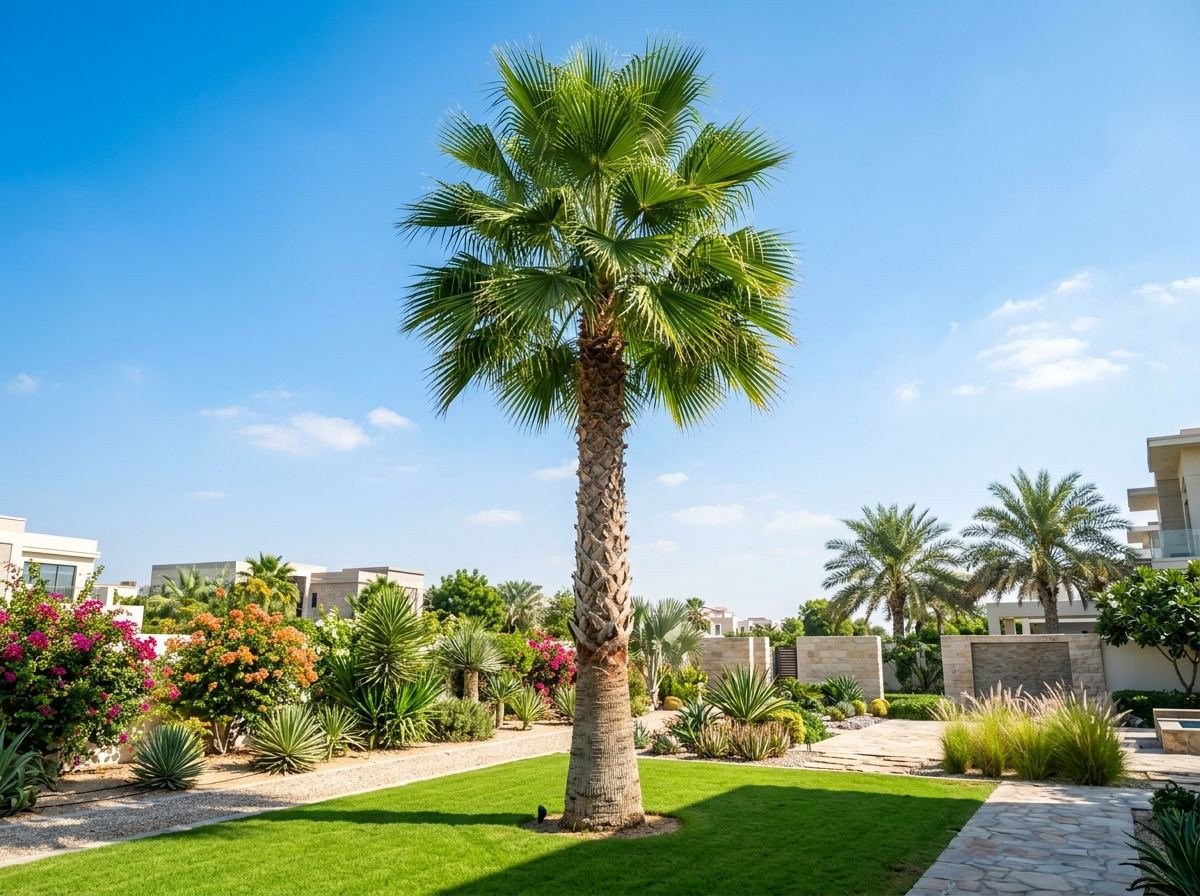
Fast-growing, wind-tolerant and available in tall clear trunks, Washingtonia palm trees create instant vertical lines along driveways and boundary walls. Growth of 80-120 cm a year is typical, which is why they dominate boulevards. Our Washingtonia supplier guide covers robusta versus filifera, trunk finishes and sizing.
Date palms and Canary Island date palms
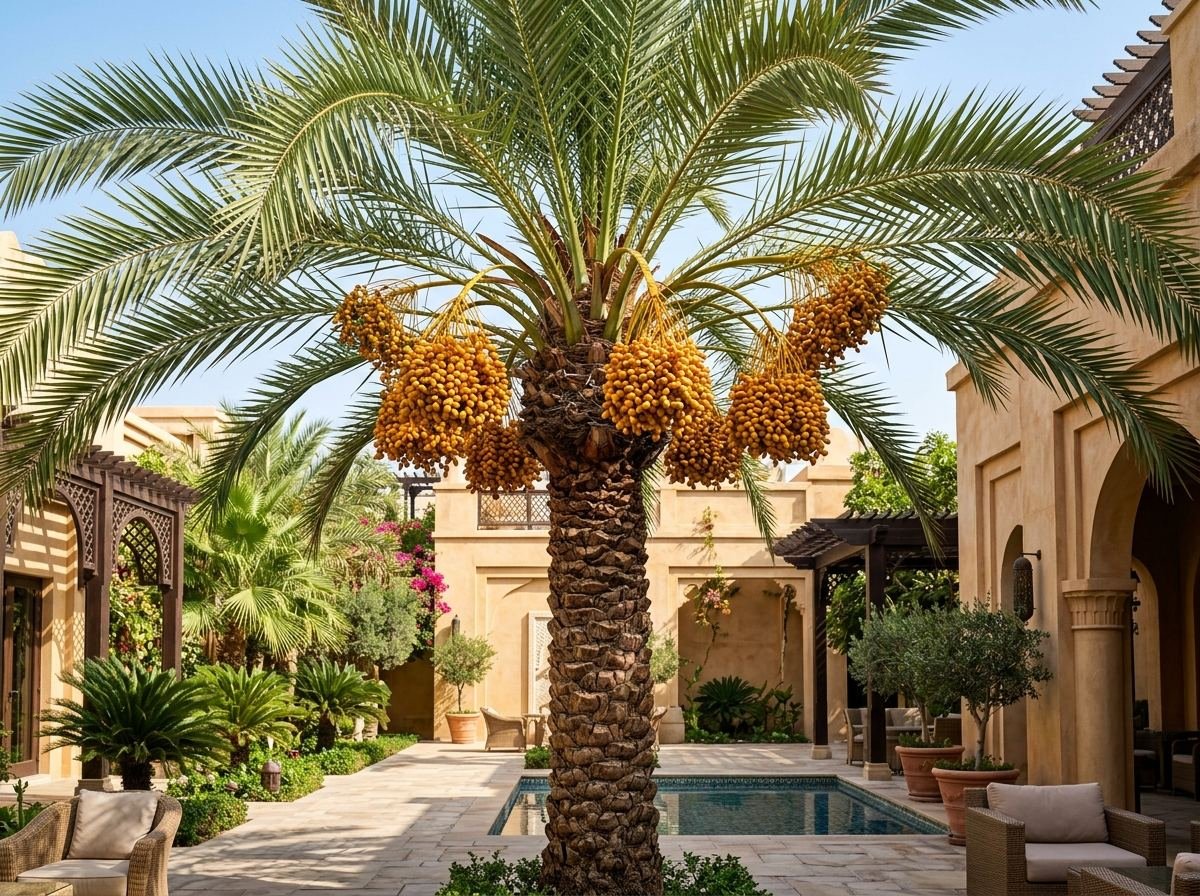
Date palms tolerate brackish water and high soil salinity, can live for a century or more and carry real cultural weight in a UAE garden. Canary Island date palms trade fruit for a dense, deep-green crown of up to 100 fronds that suits large lawns and grand entrances.
Bismarck and foxtail palms for modern villas
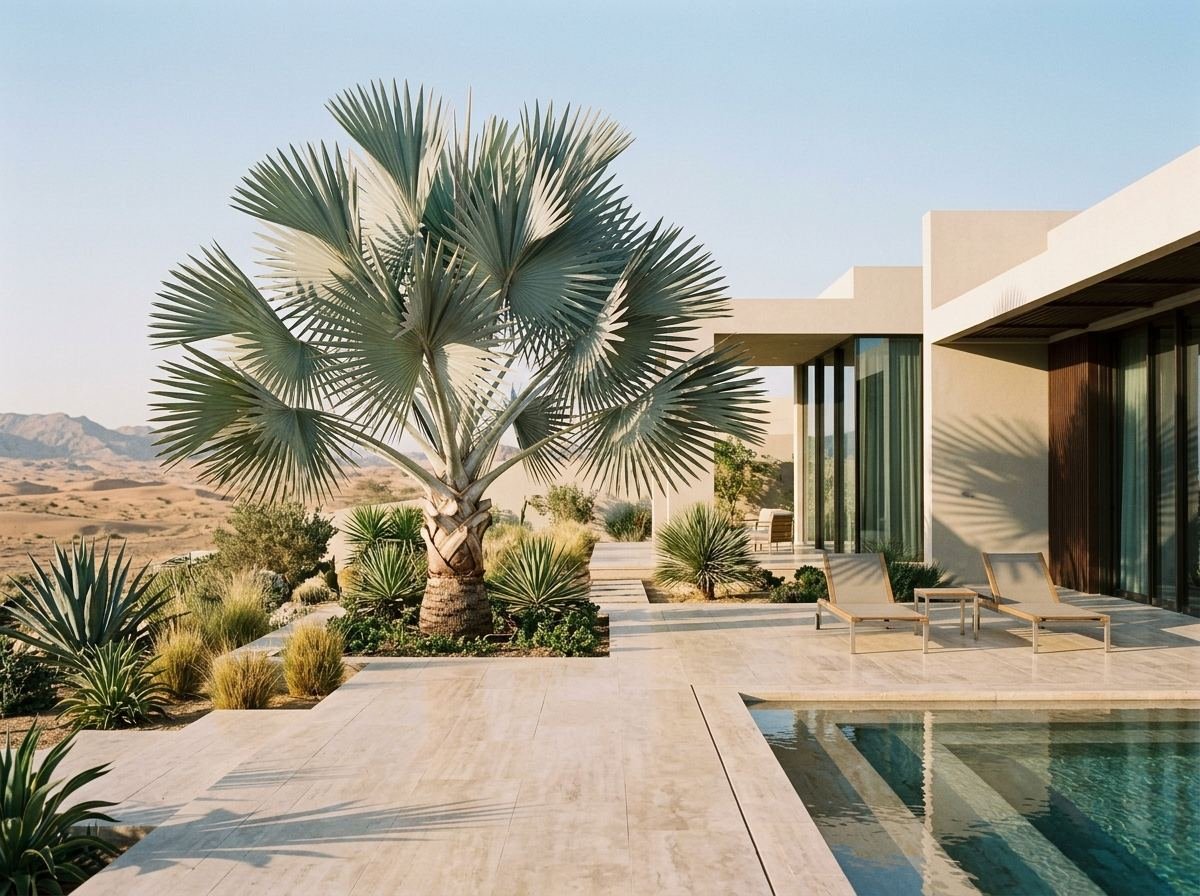
The Bismarck palm is the statement tree of contemporary Dubai villas: silver-blue fan fronds up to three metres across that contrast beautifully with pale stone and water. The foxtail palm is cleaner and more upright, and its self-cleaning habit drops old fronds without pruning, which keeps debris out of pools.
Coconut and Areca palms for coast and privacy
Coconut palms bring a tropical, curved-trunk look to sheltered, humid spots near pools and beaches, but dislike dry desert gusts and need regular deep watering. Areca palms grow in dense clusters of slender canes and are our first choice for living privacy screens along boundary walls and around patios.
Whatever you plant, every palm needs a Red Palm Weevil plan. The pest has affected date and ornamental palms across the UAE for decades (Gulf News), and pheromone-trap monitoring on new plantings is cheap insurance. Our palm tree services include it.
Native and Shade Trees for Dubai Gardens
Palms give structure, but real canopy shade, the kind that cools a patio, comes from broadleaf and acacia-type trees. These are the ones we see working best.
Ghaf (Prosopis cineraria)
The UAE's national tree since 2008, the Ghaf is drought-tolerant and can stay green even in harsh desert conditions. According to the Environment Agency - Abu Dhabi it lives for up to 120 years on average. UAE Federal Law No. 24 of 1999 prohibits cutting or uprooting wild plants, and the agency applies strict measures on felling local trees, the Ghaf above all, so planting a young one is far better than removing an old one. It is slower to build canopy than Neem, but its drought tolerance makes it the lowest-maintenance shade tree on this list.
Sidr (Ziziphus spina-christi)
One of the UAE's most resilient native species, the Sidr survives on minimal water, tolerates saline soils and produces shade and fruit where most plants fail (Khaleej Times, May 2026). The UAE National Red List describes it as a small to medium evergreen tree, up to 12 metres tall, that is highly salt tolerant, which makes it a strong choice for coastal and TSE-irrigated sites.
Samar (Vachellia / Acacia tortilis)
The flat-topped, umbrella-shaped acacia of the desert. When Umm Al Quwain's municipality urged gardeners and planners to think twice about Conocarpus, its agriculture head said alternatives such as sidr or Acacia tortilis were much better (The National, 2018).
Royal poinciana (the flame tree) and Neem
Royal poinciana, known in Dubai as the flame tree, blooms red and orange from about late April through July, thrives in six to eight hours of direct sun and is highly drought tolerant. Mature trees reach 9-12 metres with a canopy up to 15 metres wide, so it needs real space. In May 2026 Dubai Municipality launched a campaign to plant even more of them across streets, parks and neighbourhoods, noting that tens of thousands already grow in the city (Khaleej Times, May 2026). Neem is a fast-growing shade tree that the Municipality also plants along its roads; like the flame tree, it wants regular watering until established.
Garden and shade trees are sourced to order. Tell us your plot size and sun exposure and we will recommend species, sizes and spacing.
Which Outdoor Trees Should You Avoid Near a Villa in Dubai?
Avoid planting Conocarpus (Conocarpus lancifolius, locally called Damas) within reach of pipes, walls or pools. In a 2018 awareness campaign, Dubai Municipality urged villa owners to remove Damas trees because their roots grow toward water and can pass through walls, water pipes and swimming pools and push interlock and tiles upward; the tree can reach 18-20 metres (Gulf News, 2018).
Umm Al Quwain's municipality reported roots spreading horizontally up to 15 metres, noted that Dubai Municipality had received about 20 damage complaints in the previous year, and recalled that developer Emaar warned communities in 2012 to fell Damas trees because their roots were blocking drains (The National, 2018). The Dubai campaign report also notes that the Municipality itself uses the species in public landscapes, planted well away from sewage, water and electricity lines, so the problem is specifically one of residential plots. If you already have one near a boundary wall or pool, have it assessed before the roots do the assessing for you.
As a general rule, ask your landscaper for the mature root spread and canopy of any species before planting near structures, and size the spacing for the tree you will have in ten years, not the one delivered today. Palms, whose roots are fibrous rather than woody, are generally a safer choice close to buildings.
Choosing Outdoor Trees by Purpose
Start with the job the tree has to do. This table matches common needs to the species we would reach for first.
| If you need... | Consider... |
|---|---|
| Privacy along a boundary wall | Areca palm clusters at the base with a row of Washingtonia palms above for height. |
| Shade over a seating area | Ghaf, Sidr, Neem or Royal poinciana; a Canary Island date palm for a broad, dense crown over a lawn. |
| A poolside focal point | Bismarck or foxtail palms; self-cleaning foxtails keep fronds out of the water. |
| A grand driveway or avenue | Washingtonia or date palms planted in a regular rhythm. |
| Coastal or salt-spray exposure | Date palms, Washingtonia and Sidr; coconut palms only in sheltered spots. |
| The lowest possible water use | Ghaf, Sidr, Samar and, once rooted, date palms. |
| Heritage or cultural character | Date palms and Ghaf. |
For help with the whole composition (grading, lighting, paving and planting designed together), see our landscaping services. For patios and pool decks, our hardscape services cover stone, shade structures and planters.
How Much Water Do Outdoor Trees Need in Dubai?
Newly planted trees need deep, regular watering for their first 90 days; established native trees can then drop to occasional deep soaks, while palms and ornamentals need steady but efficient irrigation. How you water matters more than how much: deep watering through drip bubblers encourages roots to grow down, whereas daily surface spray keeps them shallow and vulnerable.
DEWA advises customers to use smart irrigation controllers and soil-moisture sensors and to avoid watering in the heat of the day, when evaporation wastes most of it. A UAE field study found that moving from fixed timers to soil-moisture-based scheduling cut irrigation water use by about 21% in September and 26% in October (BUiD, Smart Irrigation towards Smart Landscaping in UAE).
In practice: set separate zones for palms, shade trees and turf, because their needs differ; mulch the root zone but keep mulch off the trunk; and ease off in winter. Our care guidance for Washingtonia palms is deep drip irrigation about three times a week in summer. If your community irrigates with TSE, favour salt-tolerant species and make sure backflow prevention is in place. Our smart irrigation systems are designed around exactly this, and our garden maintenance team can fine-tune an existing system.
When Is the Best Time to Plant Trees in Dubai?
October to April is the best window, with the first half of autumn ideal. The chairman of the Emirates Astronomical Society told WAM that the first half of autumn is considered the best time for planting across the Arabian Peninsula, when seedlings are transplanted and saplings planted (Khaleej Times, September 2026). Average highs fall from about 39°C at the start of autumn to roughly 31°C by early November, so soil is cooler and transplant stress is lower.
- October-November: ideal for almost everything. Falling temperatures and warm soil give vigorous root growth.
- December-February: good for establishment. Growth slows, but roots keep developing and most of the year's rain falls now.
- March-April: still good, but start deep watering early because temperatures climb quickly.
- May-September: avoid planting young or broadleaf trees. If a project cannot wait, use hardened, root-ball-prepared specimens, plan shade protection and commission irrigation the same day.
Palms are more forgiving than most trees. A palm with a hardened root ball can be installed outside the cooler months if the pit, soil and irrigation are ready, but the aftercare is heavier, so we schedule larger plantings for autumn and winter whenever the programme allows.
How to Plant an Outdoor Tree in Dubai, Step by Step
This is the sequence our crews follow on every installation, whether it is a single palm or a boulevard of 200.
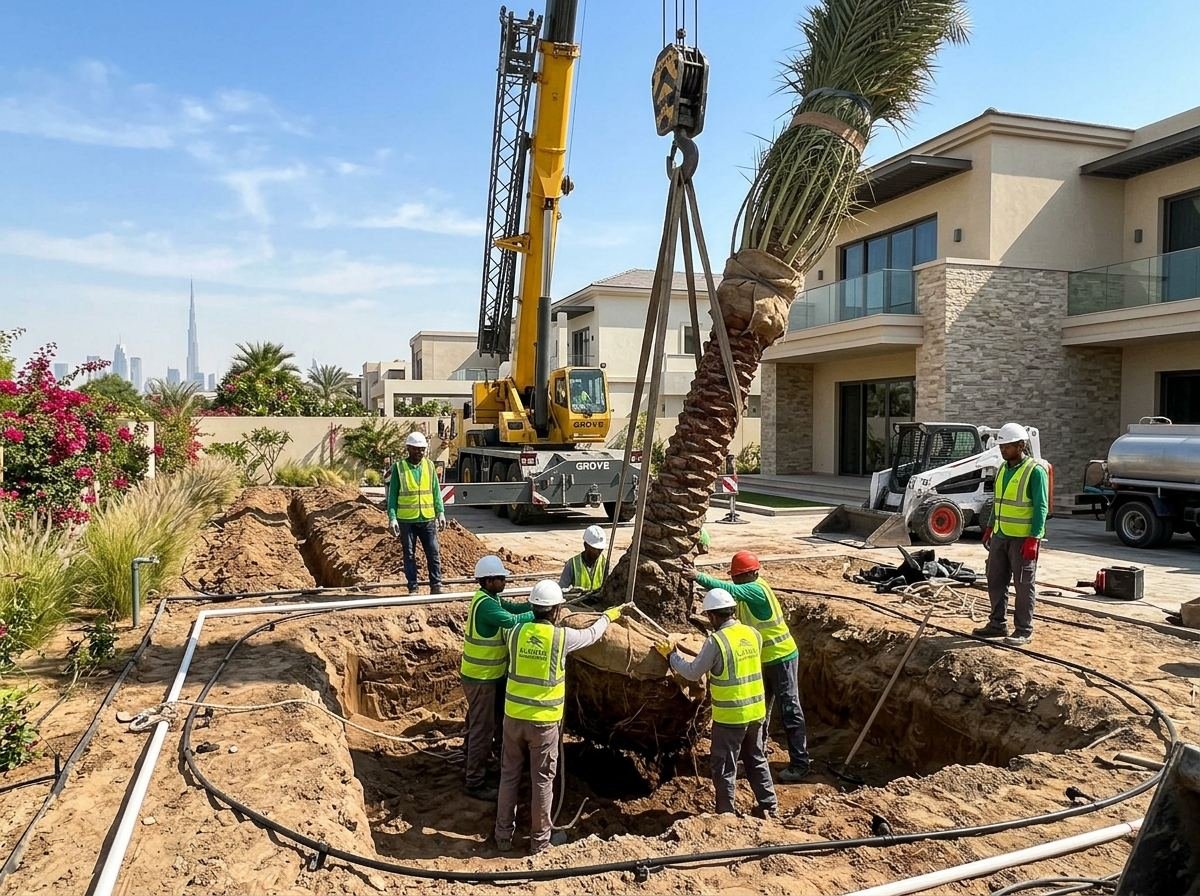
- Survey the site and scan for utilities. Check DEWA, telecom and drainage lines, overhead clearance and crane access before anything is dug.
- Choose the species for its mature size. Check height, canopy and root spread against walls, pools and services.
- Prepare the pit. Dig about twice as wide as the root ball but no deeper than it. A wide pit encourages roots to spread; a deep one lets the tree settle and sink.
- Improve the backfill. Blend native sand with compost, perlite and a water-retention amendment so the root zone holds moisture and nutrients.
- Set the tree at the right height. Keep the root flare level with, or slightly above, finished grade. Burying the root crown invites rot.
- Backfill and water in. Settle the soil with a deep initial drench to remove air pockets around the roots.
- Brace against wind. Use timber guying or underground anchoring for the first 12 weeks, until roots have taken hold.
- Install drip bubblers on a timer. Ring the root zone, not the trunk, and size the runtime to the season.
- Mulch. Spread organic mulch to cut evaporation, keeping it clear of the trunk.
- Monitor for 90 days. Check moisture, new growth and pest signs every week through the acclimatization period.
Large specimens need a crane and a trained crew. See how that works in our guide to tree supply and installation in Dubai, or browse our project gallery for completed installations.
Common Problems With Outdoor Trees in Dubai (and How to Fix Them)
Most failures come from a short list of causes, and nearly all are easier to prevent than to cure.
| What you see | Likely cause | What to do |
|---|---|---|
| Brown or scorched leaf tips and edges | Salt in irrigation water or soil; heat stress | Flush the root zone with deep irrigation, mulch, and favour salt-tolerant species. |
| Yellowing new leaves | Iron, manganese or magnesium deficiency in alkaline soil | Soil test, then chelated micronutrient feeds rather than generic fertilizer. |
| Wilting despite wet soil | Overwatering, root rot or a pit that holds water | Reduce frequency, improve drainage, and check the planting depth. |
| Leaning or rocking tree | Inadequate anchoring in shamal winds | Re-brace, avoid hard pruning, and check the root ball is firm. |
| Drooping central crown or sawdust-like material on a palm | Possible Red Palm Weevil attack | Call a specialist promptly; early treatment matters. Set up pheromone-trap monitoring. |
| Cracked paving or blocked drains near a tree | Aggressive roots (for example Conocarpus) | Have the tree assessed; consider removal or a root barrier, and re-plan spacing. |
Ongoing pruning, feeding and pest monitoring are exactly what our garden maintenance and commercial grounds maintenance programmes handle.
How Much Do Outdoor Trees Cost in Dubai?
Our current catalogue starts at AED 250 for an Areca palm and AED 850 for a Washingtonia, rising to AED 2,200 for a Bismarck palm, before crane logistics, soil and installation labour. The final figure depends on:
- Species and growth rate. Slow-maturing palms such as Bismarck and Canary Island date palms cost more than fast-growing Washingtonia of similar height.
- Clear trunk height. A 2 m tree and a 10 m tree are different categories of logistics, not just different sizes.
- Site access. Narrow gates, overhead cables and tight rear gardens add rigging time and sometimes need a different crane.
- Quantity. Bulk community orders carry a lower per-tree rate than a single delivery.
- Soil and drainage work. Poor native soil or hardpan layers need more pit engineering.
Be wary of any quote given without a site visit. Our free survey is included with every order, and our guide to choosing a palm tree seller in Dubai lists the licences to check and the questions to ask before you pay a deposit. You can see every variety and its starting price in our palm and tree catalogue.
Rules, Permits and Approvals for Planting Trees in the UAE
Rules vary by community and by what you are planting, so treat this as orientation rather than legal advice.
- Your own plot: you do not normally need a separate municipal permit to plant in a private villa garden, but master-developer or owners' association guidelines may restrict species, height or placement. Check first.
- Underground services: always clear DEWA, telecom and drainage lines before excavating.
- New developments: Dubai Municipality's Al Sa'fat Dubai Green Building System includes water-efficiency requirements that influence plant selection and irrigation design.
- Native trees: UAE Federal Law No. 24 of 1999 prohibits cutting or uprooting wild plants, and the Environment Agency - Abu Dhabi applies strict measures on felling local trees, especially the Ghaf.
- Imported plants: bringing plants into the UAE needs permits from the Ministry of Climate Change and Environment, as Khaleej Times explains. Buying from a licensed local nursery means you do not have to manage that paperwork.
Outdoor Trees Across Dubai Communities and the Other Emirates
Conditions shift across the UAE, so we match species to micro-location. Coastal communities such as Palm Jumeirah, Dubai Marina and Jumeirah deal with salt spray and higher humidity, so salt-tolerant choices such as date palms, Washingtonia and Sidr are safe bets. Inland communities such as Dubai Hills Estate, Arabian Ranches, Emirates Hills and Al Barari generally see hotter days and drier air, which favours drought-hardy trees such as Ghaf and Samar and palms on deep drip irrigation.
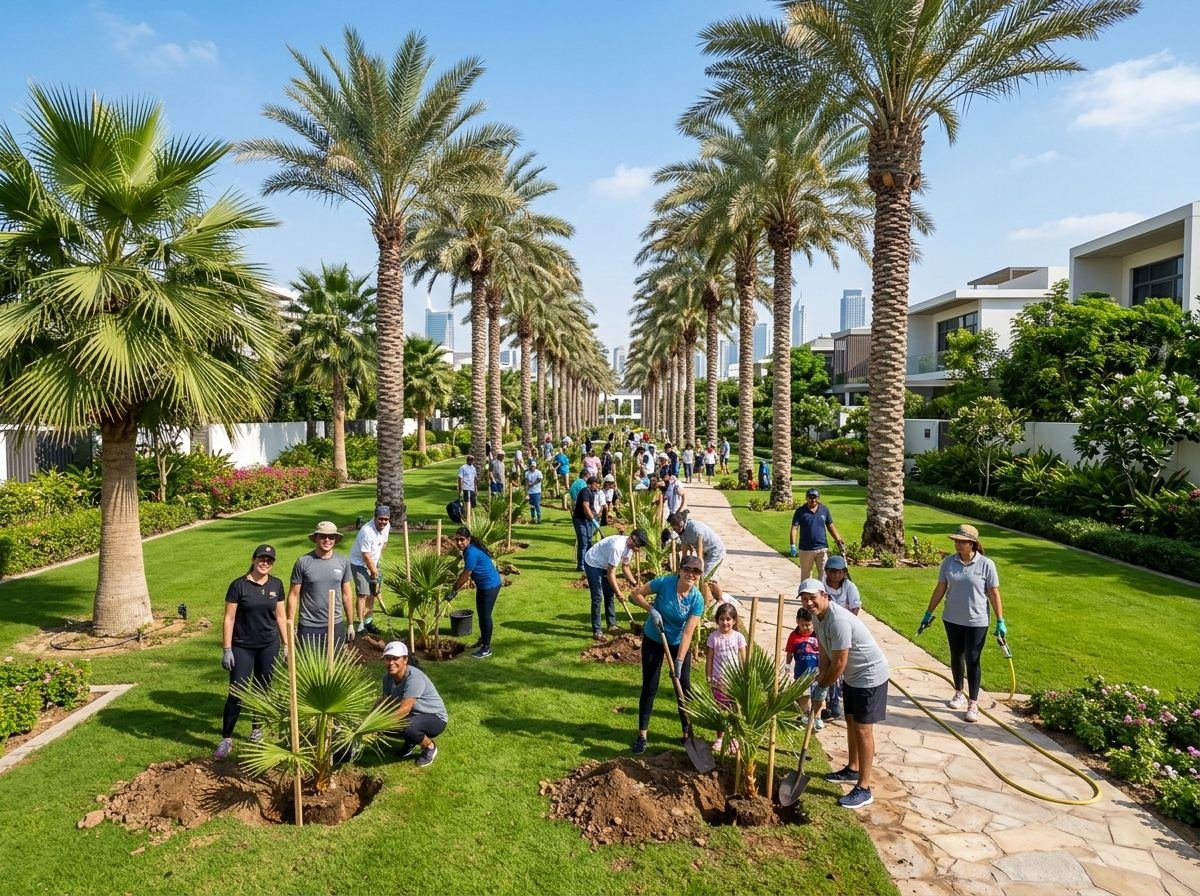
Our gallery includes work in Dubai Hills Estate, Jumeirah, Palm Jumeirah, Emirates Hills, Al Barari, Dubai Marina and JLT, and Jumeirah Golf Estates. Two examples in detail: the community palm planting at Dubai Hills and the outdoor patio and palms at a Jumeirah villa.
We supply and install across all seven emirates:
Why Buy Outdoor Trees From Palm Tree Dubai
Palm Tree Dubai LLC grows, supplies and crane-installs mature palms and garden trees from nursery grounds in Al Satwa and Al Awir. Over 15 years we have planted more than 50,000 trees, with a 99.4% post-planting survival rate.
- Acclimatized stock: specimens are hardened in our Dubai nurseries before they reach your site.
- Heavy crane fleet: 25-70 tonne hydraulic cranes lift multi-tonne trees over villa walls.
- 90-day health guarantee: every installation includes establishment monitoring and a written warranty.
- One accountable team: from supply and installation through to irrigation and ongoing care.
Learn more about our nursery and team, or contact us for a free site survey and quote anywhere in the UAE.
Outdoor Trees in Dubai: Frequently Asked Questions
What are the best outdoor trees for Dubai?
The most reliable choices are palms such as Washingtonia, date and Bismarck palms, plus native or proven shade trees such as Ghaf, Sidr, Samar and Neem. Dubai Municipality's own planting mix includes sidr, ghaf, neem, washingtonia and royal poinciana. Match the tree to the job (shade, privacy, a pool surround or a driveway) rather than choosing on looks alone.
Which outdoor trees need the least water in Dubai?
Once established, the Ghaf, Sidr and Samar (Acacia tortilis) are among the lowest-water options because they are native to arid UAE conditions. Date palms are also comparatively undemanding once rooted. Every new planting, however, needs regular deep watering through its first 90 days.
Which trees give the fastest shade in a Dubai garden?
Neem and Royal poinciana typically build a broad canopy faster than slow native species such as Ghaf. Palms such as Washingtonia grow quickly in height (around 80-120 cm a year) but give filtered rather than dense shade. For instant impact, a mature specimen can be craned into place on day one.
What is the best time to plant trees in Dubai?
October to April is the best window, and the first half of autumn is widely regarded as ideal across the Arabian Peninsula. Palms with hardened root balls are more forgiving and can be installed outside this window with careful irrigation, but young broadleaf trees are best planted in the cooler months.
How often should I water newly planted outdoor trees in Dubai?
Newly planted trees need deep, regular watering for the first 90 days, ideally through drip bubblers at the root zone. As a guide, our care advice for Washingtonia palms is deep drip irrigation about three times a week in summer, tapering in winter and as the tree establishes. DEWA recommends watering outside the hottest hours and using soil-moisture sensors to avoid waste.
Which trees should I avoid planting near my villa in Dubai?
Avoid Conocarpus (Damas) anywhere its roots can reach pipes, drains, boundary walls or a pool, and always plan spacing for a tree's mature root spread rather than its size on delivery. Palms, whose roots are fibrous, are generally a safer choice close to buildings.
Can I plant mature outdoor trees in Dubai during summer?
It is possible with hardened specimens, especially palms, but it demands more aftercare: shade protection where needed, same-day irrigation commissioning and closer monitoring. If your timeline allows, wait for October. Ask your supplier how long a tree has been acclimatizing in the UAE before it reaches your site.
How much do outdoor trees cost in Dubai?
Our current catalogue starts at AED 250 for an Areca palm, AED 850 for a Washingtonia palm and AED 2,200 for a Bismarck palm, before crane logistics, soil and installation. Shade trees are priced per site. Trunk height, quantity and site access drive the final figure, so request a free site survey for an accurate quote.
Do I need permission to plant trees in Dubai?
On your own villa plot you do not normally need a separate municipal permit, but master-community guidelines may limit species or placement, so check with your developer or owners' association. Native trees such as the Ghaf are protected, and any digging should be preceded by a utility scan. Importing plants into the UAE needs MOCCAE permits, which is why buying from a licensed local nursery is simpler.
Can Palm Tree Dubai supply and plant outdoor trees outside Dubai?
Yes. We supply and install across all seven emirates (Dubai, Abu Dhabi, Sharjah, Ajman, Ras Al Khaimah, Umm Al Quwain and Fujairah), with express 24-48 hour delivery on standard palm varieties. Contact us to arrange a free site survey.
Sources and Further Reading
Facts and figures in this guide come from the sources below. Pricing and care advice reflect Palm Tree Dubai's own catalogue and nursery experience, and the guide was last reviewed in October 2026.
- Dubai Media Office: Geographic Location & Climate
- Dubai Media Office: Dubai Municipality completes AED190 million landscaping projects (July 2025)
- Gulf News: Blue and Green Spaces Roadmap 2030 launched by Dubai Municipality (WGS 2026)
- Environment Agency - Abu Dhabi: Ghaf Tree
- Khaleej Times: Autumn in UAE to begin on September 23 (20 September 2026)
- Khaleej Times: Abu Dhabi's oldest tree: Sidra planted in 1882 (10 May 2026)
- UAE National Red List: Ziziphus spina-christi
- Gulf News: Damas tree campaign (16 September 2018)
- Khaleej Times: Sheikh Hamdan directs wider planting of flame trees (3 May 2026)
- The National: UAQ to root out damaging damas tree (2018)
- DEWA: Advice on smart irrigation to conserve water
- British University in Dubai: Testing and Evaluation of a Smart Irrigation System towards Smart Landscaping in UAE
- Dubai Municipality: Al Sa'fat Dubai Green Building System, 2nd edition (January 2023)
- Khaleej Times: UAE plans to import plants: how to obtain permits for agricultural shipments
- Gulf News: UAE wages war on deadly beetle (Red Palm Weevil)
Planning Your Outdoor Trees?
Get a free site survey and quote from Dubai's nursery and crane-installation specialists.